Stewardship is using the gifts God has given us to do the work God is calling us to do.
The Stewardship Blog
Storytelling and Stewardship
By Ginny Heckel, Stewardship Commission Member
Storytelling is one of the MOST impactful things we can do around stewardship.
The stories we share tell who we are as a parish and who we parishioners are as people of God.
We tell stories about our parish—about the history of our church and of the people in the parish, the ministries and mission of our parish, and how we serve our neighbors. We tell stories about what is going on in our parish as we reach beyond our doors. And we tell stories about our lives—our personal stories about God’s generosity in our own lives and our response of gratitude to God.
Telling a story—simply telling, or hearing a story—draws us into a relationship with another. Our stories describe our passion and commitment to God’s imperative for us to serve others. Those who listen often feel a connection with the story.
Stories have an impact on stewardship.
Through our stories, we invite people to learn something about the people of our parish—we are building relationships. Our stories attract seekers who want to know about us—who are we as people of God? What is our mission, and what are our ministries? How do we use our stewardship dollars to fulfill God’s call to serve others?
Through our stories we reach out to others. Someone may read about one of your ministries in your local newspaper or monthly magazine; or someone in a quilting group spoke about a church ministry and how they might help.
Our Stories are a way to share the good news of what God is doing in our lives and in the life of our parish.
Here are four basic kinds of stories:
HISTORY stories
What is your church’s history? What are some facts about it? These are for visitors and parishioners alike. We cannot assume that everyone in the parish knows about our history.
Facts like …. how long has the church been a church?
How did it come to be in this place – this town, this neighborhood?
You might tell a story about the early days of the formation of your church. Or stories about the banners that hang in the sanctuary. Or about the stained-glass windows.
MINISTRIES & MISSION stories
How does your church seek to serve others?
Tell a story about some of the ministries in your church – about how your parish has responded to God’s imperative to “seek and serve others.”
Craft a story that draws people in; one that makes them think, “I could help with that,” or perhaps “I want to help with that.”
Your members will learn how their pledge dollars are used to reach out to their neighbors—right across the street, down the road in town, or even far beyond their borders.
You may hear. “I have an idea…. what if we started a…., or I want to contribute financially to this ministry.”
PERSONAL STORIES
What is God doing in my life?
Telling stories of God’s presence in our lives can be a way to respond with gratitude to the goodness we have received.
Personal stories will remind those listening to think about what God has done in their lives, and the gratitude they have to God. And then when making their stewardship pledge, it will resonate.
The WE NEED STORIES
The WE NEED stories in our parishes.
It is common to ask for help in the parish by saying “WE NEED.” It is a little like a help-wanted ad.
There are lots of “We Needs” in parishes.
We need a new member of the altar guild.
We need someone to bring food for coffee hour. Or food to be delivered to a member who has experienced a health challenge or has just returned from a few weeks in rehab after an injury.
We need someone to serve on Sundays as a Lector – or as an Usher – or as a Eucharistic Minister.
We need choir members. ALWAYS
We should change the word NEED to INVITE.
We invite you to join the Stewardship Committee.
Consider asking a current choir or altar guild member to tell their stories. Ask ushers, lectors, and others who are or have served to tell their stories about serving. They might tell how they felt called to do this or talk about the reward they feel when they serve. Or they might tell a more personal story about how serving has made them feel closer to God.
At the end of the story, this question might be asked:
What is God inviting me to do?
Someone is going to hear themselves be invited, and will raise their hand, or type an email, or pick up the phone and say CHOOSE ME.
THESE STORIES ARE INVITATIONS INTO ALL OUR STORIES
WHO HEARS OUR STORIES?
Our church members and visitors who join us for worship on Sunday…or read our newsletter. Our neighbors might catch a glimpse of the story as they drive by. Our community – local and beyond.
WHERE TO TELL THE STORIES?
In church worship services, in meetings, in the parish newsletter, the church website; through social media; your local paper; the diocesan news. In our diocese (The Episcopal Diocese of Atlanta) through Connecting. Our diocese is always looking for stories about the churches, and its people, and their mission; and how they answer to what God is asking.
WHAT ARE YOUR STORIES?
Share your stories with the Commission on Stewardship via email.
Bearing Witness in the Chaos: Stewardship on the Front Lines
By Tammy Pallot, Commission on Stewardship, Chair
Stewardship, at its heart, is about answering the call: using God’s gifts to fulfill God’s calling. But what does that calling look like in practice? For me, in this season of life, that call has taken on a powerful and unexpected form: serving as both a Protest Chaplain for the Diocese of Atlanta and a Street Medic.
These roles are intertwined, a dual expression of my commitment to both physical and spiritual well-being. I strive to empower the marginalized, to amplify voices often silenced, and to ensure the safety of those who dare to speak truth to power. But beyond the practical support, I aim to be a tangible reminder of Christ’s presence amidst the tumult.
My bright yellow vest, emblazoned with “Episcopal Diocese of Atlanta Protest Chaplain,” acts as a beacon in the storm. “What is a Protest Chaplain?” is a question I hear often, and each time, it opens a door to deeper conversations. This simple question often blossoms into profound discussions about Christianity, the inclusive spirit of the Episcopal Church, and my own personal faith journey.
Ironically, standing on the frontlines of social justice in the heart of chaos has become my most profound experience of evangelism. Simply by being present, by offering a safe space, I challenge the harmful narratives that misrepresent Jesus. Without uttering a word, my presence testifies that the vitriol and division often associated with the Christian right are not the true reflection of Christ’s love.
This is stewardship in its rawest form. It’s not about grand gestures or eloquent sermons, but about showing up, being present, and using the gifts I’ve been given to serve where I’m needed most. It’s about meeting people where they are, offering both practical support and spiritual presence, and allowing God to work through us in unexpected ways.
And so, I ask: How are you using the gifts God has given you to do the work God is calling you to do? Where is God leading you to bear witness, to serve, and to love?
The Faithful Ordering of Our Finances
By Julia Gable
How do we faithfully order our finances? One way is to take time to write down the income we expect to receive in the coming year and how we plan to use this income.
This does not need to be super detailed, but a list of the broad areas of spending – and saving and giving – with the dollar amount and the percentage of income that is going toward each area.
While it is true that some families cannot predict their income or expenses in the coming year, it’s a good practice to sketch it out as best you can. The faithful ordering of our finances means we try to make changes if needed so that we can take care of our families’ basic needs and a reasonable amount of ‘wants,’ save money, and give a meaningful amount away for the good of others.
Our aim may be to increase the amount we give to the church, and if that’s not doable right away, take heart. This is a process, and it may take a few years or more to make the adjustments you’re aiming for, but that is true of many worthwhile, faithful endeavors.
Stewardship During the Season of Epiphany
By Ginny Heckel, Stewardship Commission Member
Epiphany is a quiet time in the year of the Church. This makes it a perfect time to plan your Stewardship Program for the year.
You cannot start too early. A well-developed stewardship program requires time. You are given time during the season of Epiphany.
Where to begin
BEGIN WITH PRAYER
Invite Stewardship Committee Members
Invite members of the parish to serve on the Stewardship Committee. It is important that the committee be a diverse representation of the congregation which will oversee the planning and implementation. Invite the Rector to be a member.
Determine your theme.
Develop a compelling stewardship program that resonates with the congregation, reflecting the current church focus of mission and vision. Select scripture passages that align with the choice. Build upon this for stewardship activities.
Design your program.
Lay out your plan for the year. Keep in mind the three prongs of time, talent, and treasure.
Emphasize the spiritual dimension of stewardship, linking generous giving to a deeper relationship with God.
Determine dates.
Campaign launch. Set a clear start date for the stewardship program with a well-planned kickoff event.
Consider whom to ask to speak if this is part of your plan.
Incorporate regular stewardship-focused sermons throughout the year, highlighting various aspects of giving and the impact on your community.
Keep in mind the three-prongs of Time, Talent, and Treasure, determining when and how to present.
Designate a specific Sunday for parishioners to submit their pledges. Use a separate plate for the pledges to be brought to the altar along with the collection plate.
Present to the Vestry.
Attend a vestry meeting to present the plan. Ask the vestry for their commitment in writing to make a pledge, and their commitment to pray. Ask the vestry to choose a prayer that reflects the chosen stewardship theme (provide suggestions). The prayer will be included in the Sunday bulletins and the parish newsletters, as well as all communications from the committee to the parish.
Resources
Stewardship Commission – Episcopal Diocese of Atlanta
TENS (The Episcopal Network for Stewardship)
Stewardship is Using God’s Gifts to Do God’s Work
By Ginny Heckel, Stewardship Commission Member
Stewardship is using the gifts God has given us to do the work God is calling us to do.
What are the gifts God has given us?
At our baptism, the celebrant prays for specific gifts for us from the Lord in the Spirit, including an inquiring and discerning heart, the courage to will and to persevere, a spirit to know and love God, and the gift of joy and wonder in all God’s works.
What is the work God is calling us to do with our gifts?
We find the answer in Matthew 25:35-36: For I was hungry and you gave me something to eat, I was thirsty and you gave me something to drink, I was a stranger and you invited me in, I needed clothes and you clothed me, I was sick and you looked after me, I was in prison and you came to visit me.
When are we to use the gifts?
All year round.
Year-round stewardship takes stewardship out of the “annual occurrence” category and places it where it should be – right in front of us, all year round.
Year-round stewardship strengthens and supports members of the congregation in their knowledge and understanding of their roles as God’s stewards.
Year-round stewardship means that a parish actively promotes and integrates the concept of stewardship throughout the entire year, not just during a specific campaign. This allows for a deeper understanding and practice of stewardship theology among its members, which strengthens their commitment to be responsible stewards of all God has given them.
Research shows us that giving – whether it is time, money, or even just a kind gesture – can significantly contribute to happiness of the giver. It activates reward centers in the brain, creating a positive feeling often referred to as the “helper’s high.
Resources for developing your own year-round stewardship plan include:
The Episcopal Diocese Of Atlanta’s Stewardship Commission. The commission provides a number of stewardship resources, including workshops during the year.
Visit the Stewardship Commission Page
The Episcopal Network for Stewardship (TENS) offers webinars to help prepare stewardship leaders for pledge campaigns and year-round stewardship. These are available to dioceses, vestries, and stewardship committees. Our Diocese of Atlanta provides free access to TENS. (Contact Tammy Pallot (tammypallot@gmail.com) for the password.
Our Lives Are In the Offering Plate
I’ve been thinking about the offertory sentence(s) we hear on Sunday mornings in church.
The celebrant on any Sunday will choose one of ten offertory sentences. You can find these on page 376 of The Book of Common Prayer (BCP).
The Rubrics state: The Celebrant may begin the Offertory with one of the sentences…”. The ushers then come forward to receive the offering plates, which are them passed to the congregation.
After the collection, the offerings of bread and wine, and money or other gifts are given to the celebrant. The celebrant may or may not place the plate on the altar. If they do, it remains in parishioners sight until almost the end of the service.
As parishioners come forward to receive the bread and wine, the visible offering plates are a reminder of those gifts received from and given to God.
The offertory sentences are a good way to teach about stewardship in a parish. Consider a bible study, or a reflection, on each sentence.
Offer to God a sacrifice of thanksgiving, and make your vows to the to the Most High. Psalm 50:14
Ascribe to the Lord the honor due his Name; bring offeringsand come into his courts. Psalm 96:8
Walk in love, as Christ loved us and gave himself for us, an offering and sacrifice to God. Ephesians 5:2
I appeal to you, brethren, by the mercies of God, to present yourselves as a living sacrifice, holy and acceptable to God, which is your spiritual worship. Romans 12:1
If you are offering your gift at the altar, and there remember that your brother has something against you, leave your gift there before the altar and go; first be reconciled to your brother, and the come and offer your gift: Matthew 5:23,24
Through Christ let us continually offer to God the sacrifice of praise, that is, the fruit of lips that acknowledge his Name. But do not neglect to do good and to share what you have, for such sacrifices are pleasing to God. Hebrews: 13:15,16
Or Lord our God, you are worthy to receive glory and honor and powers; because you have created all things, and by your will they were created and have their being. Revelation 4:11
Yours, O Lord, is the greatness, the power, the glory, the victory, and the majesty. For everyti9ng in heaven and on earth is yours. Yours, O Lord, is the kingdom, and you are exalted as head over all. 1 Chronicles 29:11
Let us with gladness present the offerings and oblations of our life and labor to the Lord.
I invite you to visit page 376 of the BCP and read through the sentences.
Which sentence do you hear most often in your parish?
When you hear your rector or deacon speak these words, how are you moved?
Which sentence do YOU hear when you think about giving?
What is God calling us to give? God is calling us to give Our Whole Lives.
The Response
Just when you think you have “wrapped up” your parish stewardship program… wait, there’s more!
What is your response to your stewardship campaign?
Before you put your campaign results on the shelf, take some time with your Stewardship Committee and Vestry to understand how your campaign performed, what trends you might uncover in generosity, and how your message was received by your members. Asking a few questions now can help your congregation plan for the coming year’s campaign.
It is important for the committee to meet a few weeks after the end of the campaign to discuss, and to consider the response of parishioners to the stewardship program.
TENS, The Episcopal Network for Stewardship, suggests the following when you examine your campaign success:
- How much did you raise from how many gifts?
- How many new gifts did the campaign receive?
- How many households increased their giving?
- How many households decreased their giving?
- How many pledge cards stayed the same?
- If you use electronic giving, did the number using it increase?
- Did anyone indicate that they would like information on planned giving or including the church their estate plans?
Then present the results to the parish. You are encouraged to share pledge data with your congregation.
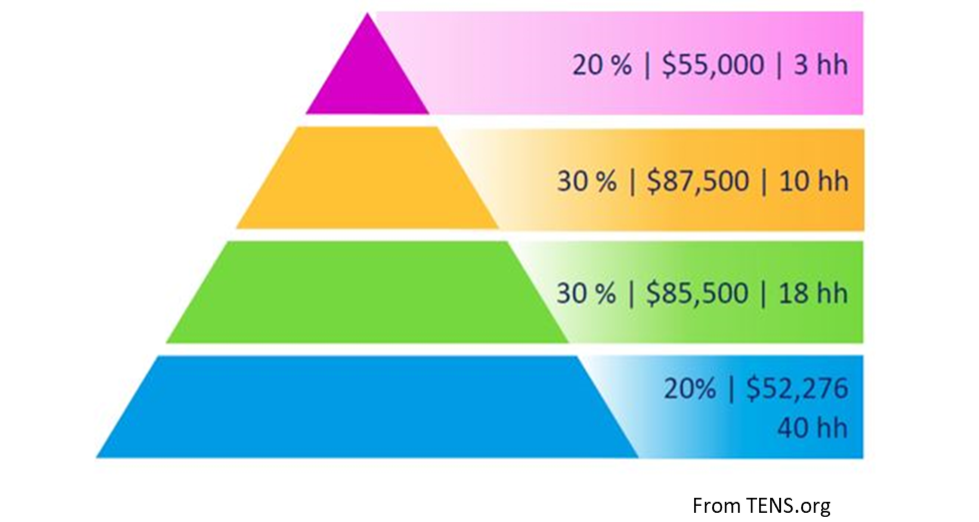
A helpful graphic that shows the results of your campaign looks like this:
The Pyramid helps us understand giving patterns. It particularly shows how the giving total is impacted by each level of giving. How do the smallest gifts combine to create a solid base for our campaign? How do the largest gifts enable our ministry?
The next step for the Stewardship Committee is to meet monthly, or every other month. Regularly. Stewardship is not simply a campaign in the fall; it is year-round. Regular committee meetings offer the opportunity to:
- Plan ways to keep stewardship on the minds of your parishioners.
- Use the parish newsletter, social media platforms, and the church website to tell the stories about how church ministries throughout the year are made possible through the generosity of parishioners.
- Present opportunities for parishioners to use their time and talent to share in church activities, programs, outreach, and more.
- Consider having a chairperson for the annual stewardship program, and a chairperson for year-round stewardship activities.
Be sure you take full advantage of all TENS offers to help you develop and enact the best stewardship programs for your parish. Sign-up for webinars. Learn about techniques and expertise to help you offer stewardship campaigns for this year and for years to follow. TENS offers webinars throughout the year.
The Diocese of Atlanta’s Stewardship Commission is a valuable resource for your stewardship committee. We offer workshops during the year and are always available for conversations about stewardship. Contact Tammy Pallot, Tammy Pallot <tammypallot@gmail.com>, for questions, and suggestions you may have. We are your stewardship resource in your diocese. Together we are partners in bringing the good news of our gratitude to God, and how to turn that gratitude into action through sharing our abundance with our neighbors, our community, and our parish.
You will find a Toolkit for Evaluating Stewardship Campaign Performance at TENS.org. The Episcopal Diocese of Atlanta has provided a TENS members for every parish. For more information about TENS and how to login with the password, contact Ginny Heckel gheckel@wt.net, a member of the Stewardship Commission.
Ginny Heckel, Stewardship Commission member.