
What is the point of examining “things done and left undone” in places connected to an Episcopal church?
Deep questions like this steered 50 parishioners at St. Mark’s Episcopal Church in LaGrange to use maps and create a recent contemplative art installation depicting their parish’s role in the city’s geographical divides of wealth, race, and more.
“To really know who we are now and where we are called to go, we have to first reckon with where we’ve been,” said The Rev. Andrew Gordon, St. Mark’s rector. “How is what we proclaim on Sundays lived out in each of our places and spaces Monday to Saturday? How can honestly confessing those things ‘done and left undone’ lead us to fuller life in Christ? This work helped us further realize and articulate that.”
Parishioners from toddlers to 80-somethings explored the history in and around their church using physical maps, as well as geographic information systems including The Episcopal Church’s Neighborhood Exploration Tool. With discoveries of how race, poverty, food insecurity, and insurance gaps are worse in certain areas, the St. Mark’s congregants created a series of collaged panels.
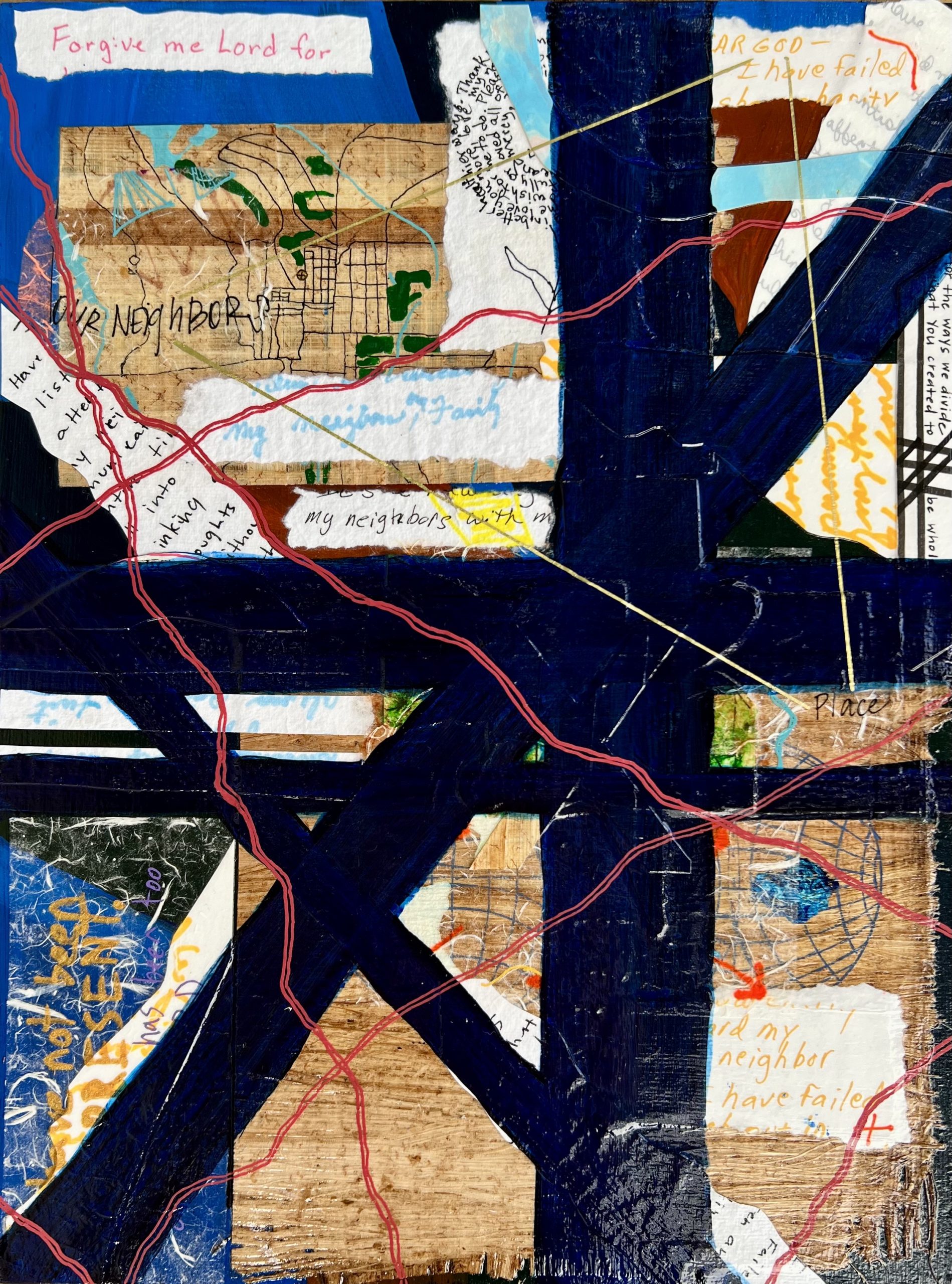
“By what we have done and what we have left undone,” spelled out in raised black letters, features congregants’ confessions as a backdrop to red mapping lines. “We have not loved you with our whole heart; We have not loved our neighbors as ourselves,” is similar, with written or drawn confessional prayers collaged into a map overlaid with dividing and connecting lines.
These two panels “are representative both of the content of the series but also of the level of collaboration by the St. Mark’s community,” said St. Mark’s member Jenn Craft. The layered creations hide full images and texts, suggesting “the ways that our places are both layered with meaning and with the history of our collective and personal sin, both confessed and left unconfessed,” she added. “Some marks show through while others remain permanently obscured.”
Craft is the project leader, an artist, and professor of theology and humanities at nearby Point University, where she teaches systematic theology, philosophy, and the arts. She is writing a book on Christian theology and cultural “sins of place” like immigration or gentrification. Her Teacher-Scholar grant from the Calvin Institute for Christian Worship, which receives generous support from the Lilly Foundation Inc., funded the project.
Through the project, parishioners examined what St. Mark’s did or ignored in LaGrange’s development. The church was founded in 1864, but did not have its own building until 1893; the congregation worshiped in nearby churches that were Presbyterian and Methodist, for example.
Today the city around St. Mark’s has 30,000 people. The current church was built in 1949, and about 100 worship each Sunday, with 427 members on the rolls. One prominent feature at St. Mark’s is a Celtic cross made of stone, with three questions etched on it: Who are you? Where are you going? Why?
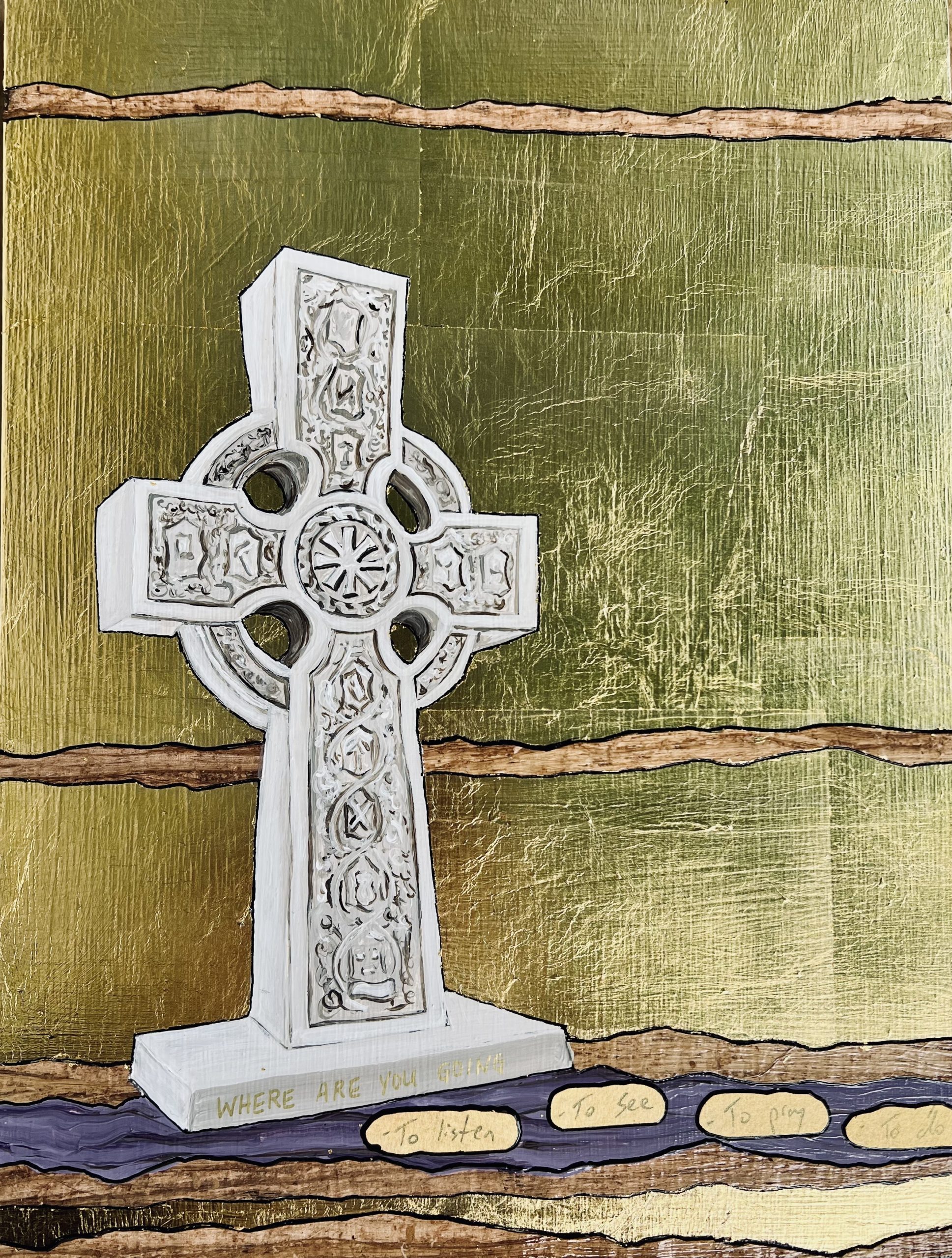
“Over the last couple of years, we’ve spent time considering and discerning together how we might answer those questions,” Gordon said. “Jenn’s work on this project has been a holy invitation to further explore who we’ve been, we are now, and who we are called to be in this time and place. She asked us to consider deeply and prayerfully how we relate to our place, encouraging us to be placemakers in our own little ways. The project has generated thoughtful conversation and exciting momentum, and has left us with lots of hard, faithful questions to ponder and pray in our place.”
By naming, confessing, and artistically representing the church’s place in historical practices—like sins are named and confessed in the Episcopal liturgy— the congregation expects to more deeply connect with their community and one another.
“Our congregation is very interested in finding ways to be involved in the issues embedded in our community and is, for the most part, willing to have difficult conversations about race, poverty, and environmental concerns that affect our city,” Craft said.
“Sins of place”
St. Mark’s project began during Lent with a five-week Wednesday night series, “Confessing Sins of Place.” The timing “provided a somber and emotionally vulnerable place to think about sin and confession,” Craft said. “It’s not an easy subject to sustain conversation on, and I’m so proud of the way that our community cares deeply enough about these things to experience that discomfort.”
She and Gordon reinforced that confession is about (re)orientation to God and one another in community, not about shame and guilt. One can always be confident that God forgives sin and moves a person toward reconciliation, after the necessary step of confession.
While The Episcopal Church has promoted racial reconciliation efforts, Craft observed that predominantly white parishes like St. Mark’s often prefer skipping the essential step of confession. “We cannot reconcile what has not been confessed,” she pointed out.
In the Lenten series, St. Mark’s parishioners were encouraged to “stop, dwell in confession, contemplate our own sin and the sin present in our places,” she added. “Only when self-reflection has happened, move onto the work of reconciliation and repair.”
Place, they learned, is also a theological concept. On the cross, many Christians believe, Jesus took the place of sinners. Through this project, St. Mark’s members could consider their own history and the history of the place in complexifying ways while beginning to name the ways that the Spirit of God may be continually calling the Church to ongoing work of confession, repentance, and repair in the world. They could place repentance deeply as they asked God’s forgiveness, while reimagining the work the church is called to do in this time and place.
Maps of History, Today, and as Metaphors
Parishioners studied historical and current maps of LaGrange, including insurance maps from the 1920s to 1950s that designated racial and socioeconomic divisions. Older, longtime church members shared memories of the city and St. Mark’s.
“I was really blown away by the historical knowledge that members of the congregation contributed to the discussion,” said Craft, whose family joined St. Mark’s two years earlier.
Her children, aged 2 and 4, helped gather plastic at West Point Lake that became part of a panel representing environmental irresponsibility. “We had congregants of every other age range, including middle schoolers, the middle aged, and folks into their 80s,” she added. “We really wanted as diverse a range of people represented in this project, and I think we got a really good turnout.”

One panel is a poverty map of the city of LaGrange (“We have been ignorant of and indifferent to the sins written in our landscape… to poverty and extreme socioeconomic divisions”). Darker areas represent extreme poverty, which often corresponds with racial, health, and education markers, while lighter portions of the map represent higher wealth. The panel features biblical references to wealth and poverty, reminders of Jesus’ instructions on how to live.
“Art is one very central way that we go about understanding and identifying with our places, and it also challenges us to step outside of our normal ways of seeing things to form our imaginations anew,” Craft said. “Because of that, participation in the arts can be a way to reshape our current ways of seeing and encourage new practices related to our lives in place.”
Gordon said he “learned so much–from in-depth study of old maps of town to workshops on how to properly apply gold leaf. Jenn’s project was one of constant learning opportunities.”
The art was unveiled in a service in August. In her homily, Craft urged each participation to “consider themselves an artist of the work. It is their artwork, not mine, that visitors see there, and it sits as a direct expression of the community’s involvement in this time and place.”
The project left Craft with “hope for the future of these types of conversations on a congregation level and within the wider community. The work is slow and difficult and takes many different turns that you don’t expect. But the Holy Spirit works within our places to shape our imaginations and practices anew.”
Exploring Place at Your Parish
Craft suggested these resources for parishes that want to explore place.
- Explore your Neighborhood GIS tool provided by the General Convention (https://generalconvention.org/explore-your-neighborhood/). You can create maps of your area based on race, healthcare, wealth, etc. and begin to understand some divisions that are often actually built into the landscape of your city. Demographic data serves as a crucial tool for planning the future of the Episcopal Church.
- Local archives are treasure troves of information, and you may encounter an archivist who loves helping you find what you need. Craft used local archives to find physical Sanborn insurance maps of St. Mark’s local area, which fueled a lot of conversation leading to the contemplative art installation.
- Collage can be a powerful way to capture how histories, stories, and confessions are often covered and uncovered as places form.
- Some books that address themes in this project include:
- David W. Swanson, The Tangled Roots of Racial and Environmental Injustice (IVP 2024)
- Jennifer Allen Craft, Placemaking and the Arts: Cultivating the Christian Life (IVP Academic 2018)
- Jennifer McBride, The Church for the World: A Theology of Public Witness (Oxford 2012)
MapDash is another tool available through the Diocese of Atlanta that allows you to explore the area around your congregation through the lenses of population characteristics, community issues, and community resources. Depending on your needs, the Office of Congregational Vitality can create community maps, reports, and statistics for your church’s neighborhood and/or pair you with a consultant to walk you through the data for your neighborhood.