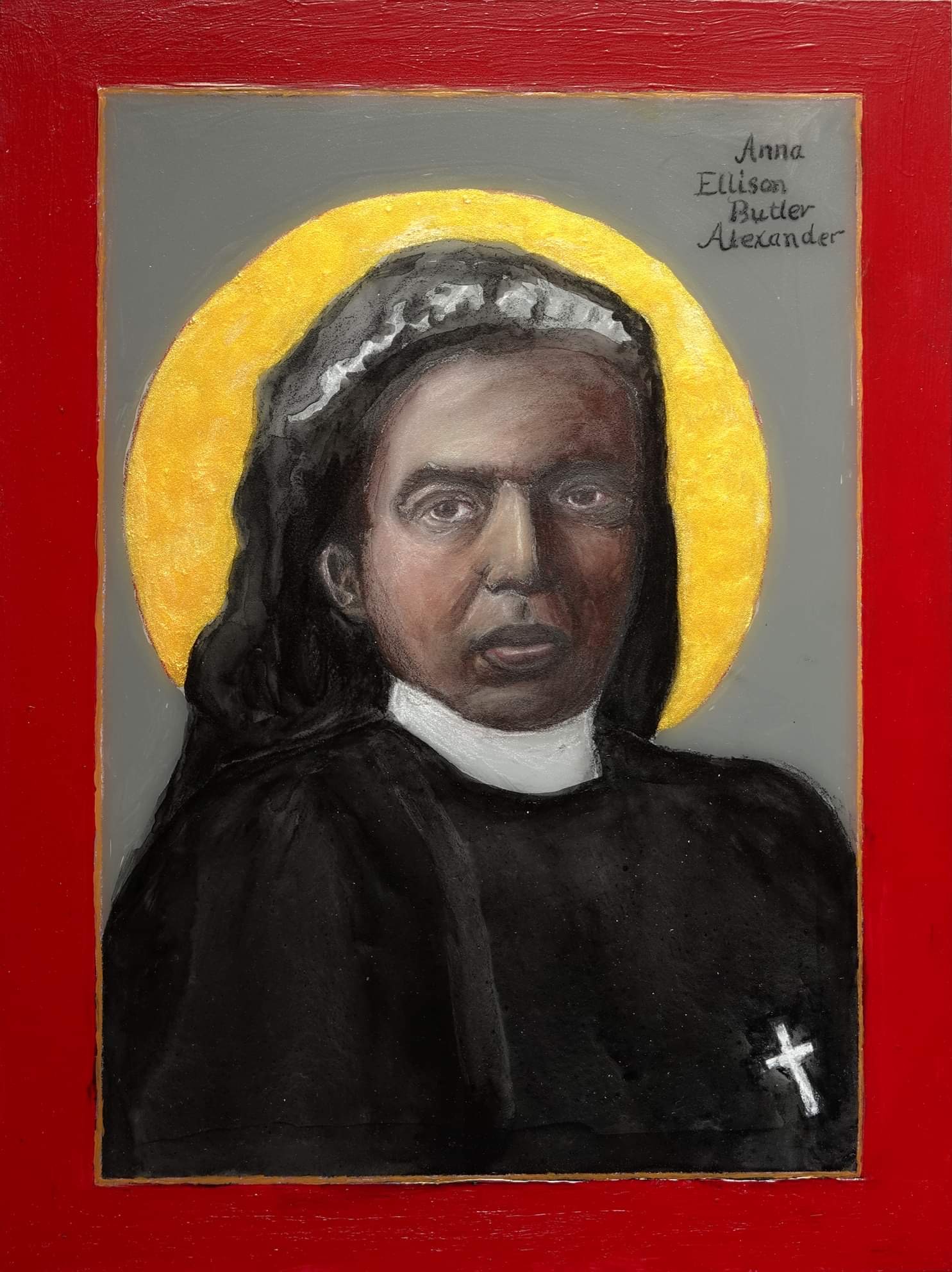

Presiding Bishop Sean W. Rowe and over 200 clergy from the Diocese of Georgia and the Diocese of Atlanta gathered at Rock Eagle 4-H Center in Eatonton from September 22-24 with the goal “to be effective witnesses” in the footsteps of St. Matthew and Anna Ellison Butler Alexander (1865-1947), Patron Saint of the Diocese of Georgia and the only Black deaconess in The Episcopal Church.
“We have a particular way of being, a particular way of seeing the world, and it’s much more compelling than the gospel of dominion and domination that is out there as the prevalent Christian narrative now,” said Rowe.
Amid Christian nationalism and distrust of institutions, The Episcopal Church may be one of the last institutions staking its privilege and bearing witness to Christ as the only reality, Rowe said.
But witnessing boldly, he warned, requires going beyond virtue signaling and may mean losing social status.
Episcopalians need “to collectively mobilize and take all this privilege that we have garnered up to this point, that we’re the church of the presidents and the Supreme Court and the most senators—all this stuff that we talk about all the time when we’re nostalgic—that is capital that’s going to have to be spent. I wonder if we’ll have the National Cathedral. I wonder if we’re going to be any of that anymore. That’s all on the line now as we enter this particular period of history.”
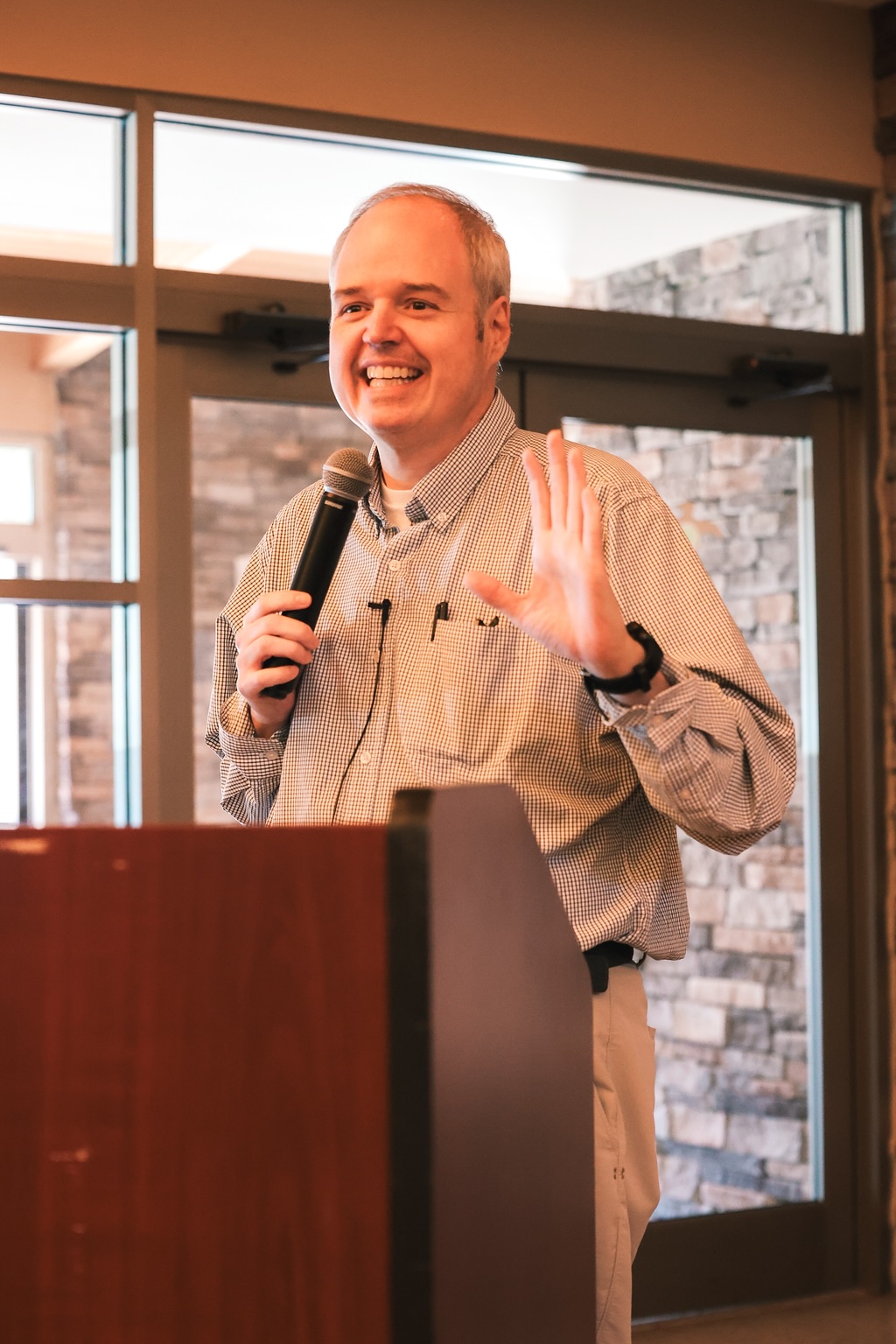
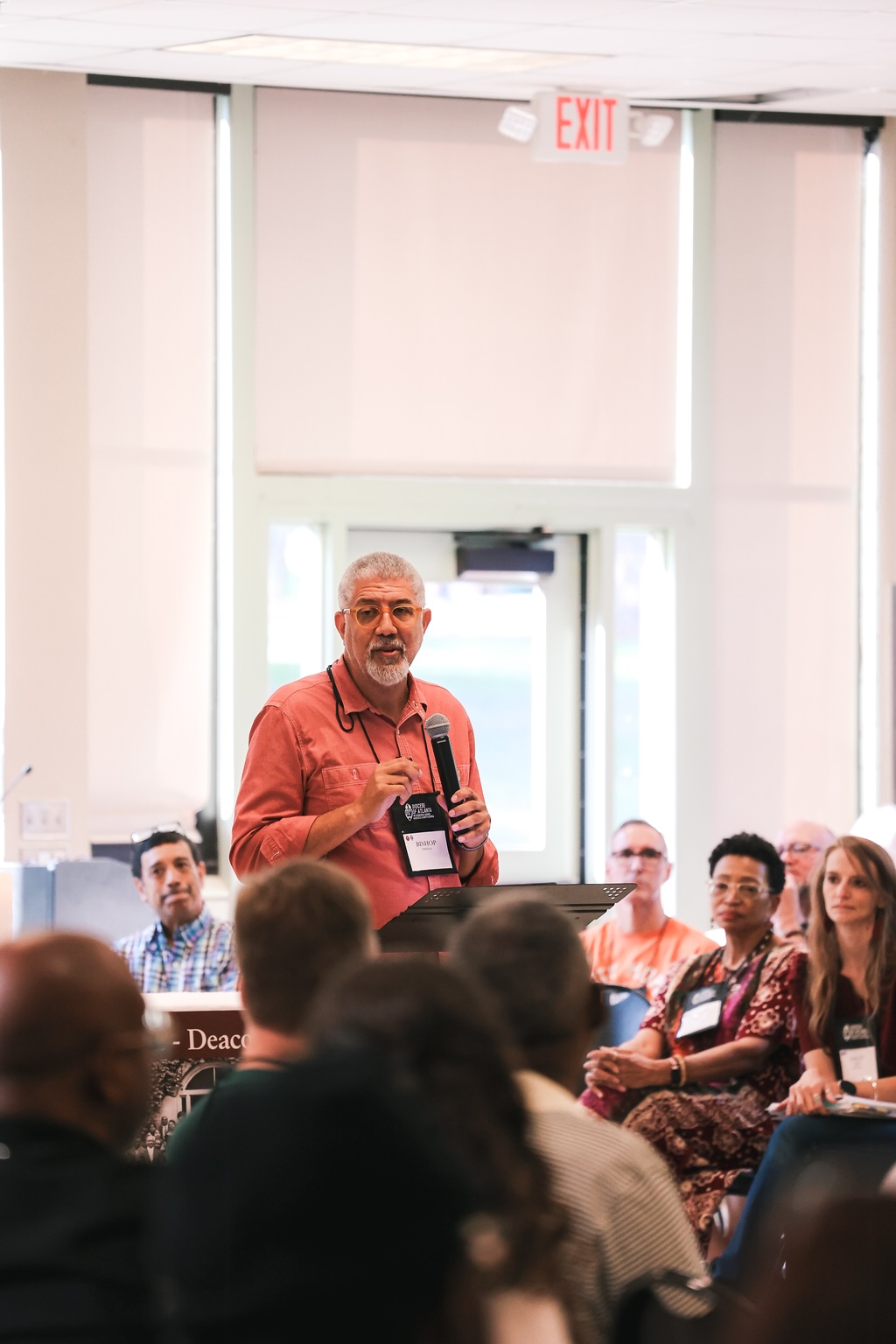
Clergy also heard from Atlanta Bishop Rob Wright, who celebrated shared historical roots alongside conference speaker Georgia Bishop Frank Logue. “How does a daughter welcome a mother?” Wright said in welcoming remarks.
The mother Diocese of Georgia established in 1733 as the colony of Georgia did. The diocese now covers 83 counties, running from the Chattahoochee River west of Americus to the Savannah River north of Augusta. Savannah is the see city. Logue is the eleventh Bishop of Georgia, ordained and consecrated in 2020.
The daughter Diocese of Atlanta was created in 1907, and its first bishop, the Rt. Rev. Cleland Kinchloch Nelson, had served in that role for the Diocese of Georgia for 15 years prior. The diocese now covers 75 ½ counties in middle and north Georgia and encompasses 120 worshipping communities. Wright is the first African American Bishop of Atlanta, installed in 2012.
Presiding Bishop Rowe: Getting Out of Our Own Way
In two sessions, Rowe candidly laid out the need for Episcopalian unity and focus, especially given current events and political violence. He advocated for changing the common mindset of “being the smartest person in the room” and erasing “dangerous rhetoric, budgets and behaviors” that undermine trust in The Episcopal Church as an institution.
“The strength of our witness depends on it,” he said. “I believe now in this time we are not going to be able to stand alone. We’ll have to stand as a community.”
Justice, courage, and honesty create an effective, collective witness. The Episcopal Church has “a legacy that has some bad in it [and that] we could use for the transformation of the world and the culture that we’re in, if we could get out of our own way,” he said.
“To carry on our traditions and our practices, we must have some kind of framework,” he said.
Rowe offered several insights into making that happen “together, rather than as a group of individuals who do performatively self-righteous things disconnected to the communities around us.”
Re-orient the Circle
“We do the Christian gospel and the Christian message a disservice when we think of ourselves at the middle and then we think of ourselves as expanding the boundaries to include all people when really, it’s the other way around,” Rowe said.
Referring to the work of The Rev. Canon Kelly Brown Douglas, Canon Theologian at the National Cathedral, Rowe said that “in God’s kingdom and in God’s economy, the marginalized, immigrants, refugees, the poor, the fearful, the alone, are at the center. They are at the center of the story. They’re the bearers of the salvation of the world, their struggles reveal to us the kingdom of God. And so, as witnesses of the gospel, we put their story at the center. So, when we when we reach out, we’re reaching out to the center. We’re going to the center, rather than extending the circle.”
Speak the Gospel Under Pressure
“In Acts, the church finds her voice under pressure,” Rowe said, quoting The Rt. Rev. Dr. Justin S. Holcomb, Bishop of Central Florida.
In the early church, “as the gospel advances through headwinds, there are barriers of geography, ethnicity, culture, language and wealth, and many of these barriers appear so inviolable that when the gospel is preached to a new segment of society, riots ensue,” Rowe said.
“They were preaching the gospel of Jesus Christ in their own way, in their own place, challenges like demonic forces, worldly powers and authorities, governmental opposition, intense suffering and bloody persecution, unjust imprisonment, unbelief, internal disunity and shipwrecks and snakes. But even with all this swirling, the apostles keep preaching that all authority in heaven on earth has been given to the risen Christ, that the fracture of the world that began in the earliest chapters of Genesis is being mended and the gospel is spread. If you notice what they do, they preach the gospel. They make testimony. They’re not trying to be right about something.”
Rowe led clergy in a reflection on discernment from Acts 15 “that will help us stay clear-eyed and know when to speak and act,” he said.
To be effective witnesses, discerning “what has to give is pretty significant,” he added. The earliest followers of Christ face “a long history of things the way they are. What constitutes inclusion, what it means to come into the fold that’s now being set aside, and there’s real disagreement about that, and they’re not always particularly humble about it, but they get there. Because ultimately, what they do in the face of all that chaos, is preach the gospel over and over and over again in ways that are very clear, not always popular, but very clear.”
Christ is Reality Manifested
In the early 1940s, as Germans faced an urgent need to resist National Socialism, theologian Dietrich Bonhoeffer wrote about Christian ethics that Rowe sees as relevant today.
“We can and should speak about how Christ may take form among us here,” Rowe said. “All that matters is that Christ is the reality… it’s a profound and revolutionary way of thinking about Christian ethics, which is to say, it’s not about being right or having a principle that we’re going to apply every time; it’s how Christ is manifest now for us in our time, right now.”
Rowe acknowledged the scholarship of The Rev. Dr. Jennifer McBride, Associate Rector of Formation at All Saints’ Atlanta and author of “The Church for the World: A Theology of Public Witness,” based on Bonhoeffer’s writings.
Get Out of the Village
In Mark Chapter 8, Jesus heals a blind man after taking him out of the city. “For whatever reason, I don’t think he can really be healed in that place,” Rowe said. “Jesus has to take him out, and [healing] takes two whacks. The first touch doesn’t work.
“We have to figure out a way to get outside of the village. Now, what’s the village?” Rowe asked. “Could be the people we’re around. Could be some of the practices we need to let go of. Could be our own provincial sensibilities. Could be what we want instead of what God might want for us.
“Now is the time for us to think about what it’s going to mean to get to a place where we can actually be touched by Jesus and that we can have the imagination of God,” he said to the clergy. “And you’re the critical piece. What you’re doing in your parishes and institutions, that’s where it’s happening—at the local level.”
Bishop Wright: De-centering One’s Self
Freshly arrived from sabbatical, Bishop Wright analyzed the first meeting of Jesus and Matthew (Matthew chapter 9) as inspiration for effective witnessing.
As soon as Jesus walks toward him, Matthew’s life changes because Jesus sees, addresses, and invites him.
“Jesus doesn’t give Matthew any details that day, just a concise, all-encompassing raison d’être: ‘Follow me,’” Wright said. “No sooner than Matthew is called, he’s at a dinner party with all sorts and conditions of folks. Did you see that he’s watching Jesus teach the teachers of the faith expose contradictions and practice alternative behaviors? He’s learning that life for him now will be defined by his proximity to Jesus’s purposes. That’s where your life is.”
Effective witnessing comes from releasing self-doubt and imposter syndrome, de-centering the self, and boldly “giving ourselves away,” he added.
“It is possible, in this vocation, to take on a form of godliness while denying the power thereof. Yes, I give myself away. Who better to be trusted with your life? Yes, and yes, again and yes, one more time, I hope that in our time together, in worship, the meals, the presentations and the fellowship, you are inspired and revived to be the most effective witness for Jesus that you have ever been.”

Logue pointed to Alexander’s indefatigable service as an example of effective witnessing because she responded to “a unique view of an occurrence. The witness shares what they experienced or what they saw happen.”
Alexander “saw that there was a whole system keeping the children down. Everything was stacked against them. The scales of justice were not balanced in their favor, the odds were long against the children of her community, ever making their way in the world or finding a better life,” he said.
And then, as she took the next faithful step, she wasn’t caught up in being effective, which courts “a little bit of a spiritual danger,” Logue warned.
“Really all I can focus on is me being faithful. Because if I worry about being effective, then it can be about me and my ministry, and how it’s productive, and how success in that might get me a next place higher up in the ladder … it can be ‘all about me.’ But I think if we make the operative word ‘witness,’ then something else happens.”
Something miraculous, even. Despite being the youngest of 11 children born on a plantation to recently emancipated slaves, Alexander taught children to read—by tradition, from the Book of Common Prayer and the Bible—in a one-room schoolhouse.
“It’s really her God-given gifts and her passion for bettering the lives of those around her that we see made her an extraordinarily effective witness to the good news,” Logue said.
Alexander ministered for 53 years, wearing the distinctive dress of a deaconess, traveling by foot, showing care and love for all whom she met.
“She accomplished so much more than she could have ever, ever done on her own,” Logue said, invoking Matt. 11:30 from the gospel reading. “The image of a yoke reveals that the work of the gospel is not our work. The yoke is Jesus’ yoke, and Jesus is pulling alongside of us in this, in the yoke that is easy and the burden that is light is because our savior’s work with us.”