by The Episcopal Diocese of Atlanta
What stabilizes local Episcopalians and their parishes in disorienting times like the present? Clergy from across the Diocese of Atlanta recently zeroed in on what it means to live out their call these days and stay grounded in timeless faith and energy.
"Our anchor for today and the future is God," said Bishop Rob Wright, centering on the promise of the resurrection. "God hasn't brought me this far down the path to abandon me here."

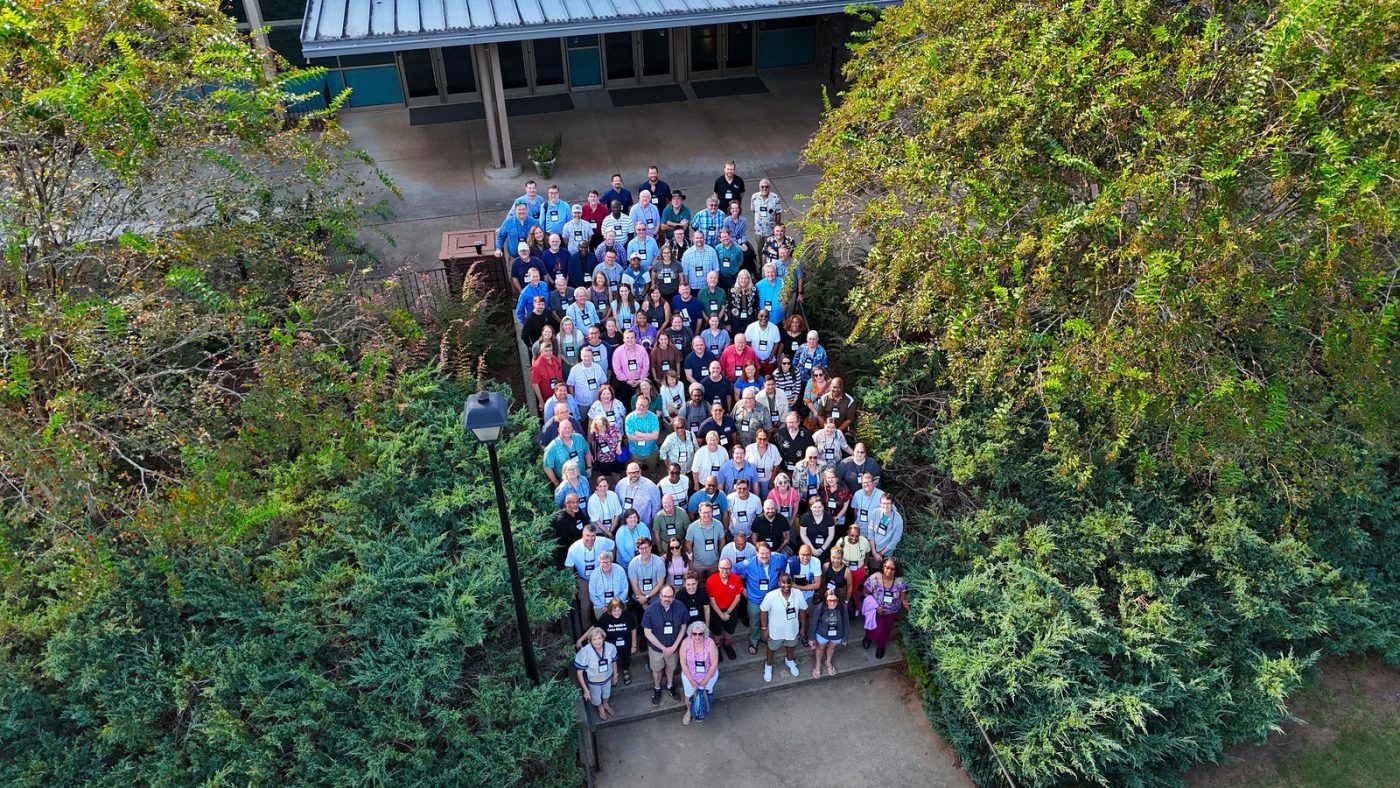
The 2026 Clergy Conference, held Sept 14-16 at the Rock Eagle 4-H Conference Center in Eatonton, drew clergy representing the 120 worshiping communities across middle and north Georgia.
“Anchored for the Future” was the theme, and speakers reflected on remaining steadfast in the diocesan purpose—to challenge themselves and the world to love like Jesus by worshipping joyfully, serving compassionately, and growing spiritually.
Anchoring “is exactly what the zeitgeist calls for right now,” Wright said. “It’s for us to re-tune to that godly hope in the face of an ocean of despair out there, and malaise and numbness and weariness.”

Okorie “OkCello” Johnson offered an improvised musical piece following each meditation, drawing inspiration from and reflecting on its central theme.
A verse from Hebrews, "We have this hope, a sure and steadfast anchor of the soul, a hope that enters the inner shrine behind the curtain" (Heb. 6:19), provided the conference throughline.
The content of this year’s Clergy Conference centered around four reflections about what it means to live out our call in this time. Presenters also explained how parochial data, spiritual practices, and outward-facing mission offer timely solutions for strengthening congregational vitality.
Opening Meditation — The Rev. Dr. Stuart Higginbotham: Sustaining Ministry in the Spirit

The Rev. Dr. Stuart Higginbotham, rector of Grace Episcopal Church in Gainesville, invited clergy to explore spiritual practices to sustain them amid pressures of life and ministry.
Through poetry, silence, writing prompts, and reflection, clergy considered the tension between fear and their relationship with the Spirit. Hope, he said, is a living connection with Christ that grounds and transforms people even in rough times. “Embodied hope is the antidote to the poison of fear,” he said.
Higginbotham shared a meditation on stability through an image of a boat, anchor, and chain. The chain’s weight and length, not just the anchor, help hold a vessel steady. Clergy responded by identifying practices that strengthen their “anchor hold.”
They were also encouraged to exercise their imagination through nature, scripture, and thinkers such as Hildegard of Bingen. Higginbotham also challenged ministry focused only on performance or preservation.
"Let us be curers of souls rather than curators of guarded exhibits," he said.
Second Meditation — The Very Rev. Fabio Sotelo: Anchoring Dignity and Respect for Immigrants
As immigrants across north and middle Georgia battle the ongoing tempestade (storm) of ICE sweeps and public suspicion, The Rev. Fabio Sotelo said a big question is, “Cuál es nuestra ancla? (What is my anchor?)”

Sotelo, rector of St. Edward's Lawrenceville, leads multilingual, multicultural services. He said that the intentional targeting and destabilizing of immigrants, especially children, takes away their humanity.
“Our dignity doesn't come from citizenship, immigration status, employment, productivity, education, religion, income, documents, or usefulness,” he said. “Our dignity comes before all of those things.”
For immigrants and everyone, the most important anchors are faith in God’s promises, a supportive community, and trust in one another. Parishes can and should be havens in the storm: preaching, visiting, donating, writing letters, helping people leave detention, changing hearts and minds, and transforming society. Doing so creates shared purpose.
"We are all immigrants," Sotelo said. “Human beings are immigrants, period."
Third Meditation — Sally Ulrey: Rooting Vitality in Active Mission, Not Survival
Sally Ulrey, Canon for Congregational Vitality, pointed clergy to the essential foundations that hold a congregation steady when the surrounding world feels chaotic. She urged clergy and congregations not to retreat into paralysis or wait for calmer times. Instead, listen for the next faithful step, like Moses, Elijah, and disciples who found renewed identity through encounters with God.

Ulrey distinguished viability—merely enduring—from vitality: a community’s active life, energy, and mission. Data from Atlanta congregations indicates that inward focus alone falls short; long-term strength relies on spiritual growth, a clear identity, and genuine neighborhood relationships.
Resilience requires discernment—listening to God, one another, and neighbors, then experimenting and adapting together.
“Keep the main thing the main thing,” Ulrey says. “We can be anchored and active.”
Final Meditation — Bishop Rob Wright
Wright urged clergy to anchor their ministries in hope and loosen their grip on outcomes, because faithfulness means following God into an uncertain future.
Speaking on “Anchored for the Future,” Wright described hope as a response to grief and upheaval. “Christian hope is the confidence that God is already present in the future,” he said.
He called liturgy a means of helping congregations practice that hope, urging clergy to choose the most germane hymns and prayers and speak about God as active now.
“Relinquishment is not resignation,” Wright said. Resignation declares nothing more can be done; relinquishment asks, “What might God be up to?”
His recommendations included facing personal fears, assessing whether congregational practice matches stated purpose, deepening understanding of Christian hope, and risking strategic, data-driven, faithful experiments.
“The future of the church is not fundamentally a demographic problem, or a financial problem, or a political problem, or even an institutional problem,” Wright said. “Those matters live beneath a spiritual question: Do we trust Jesus enough to follow Him into a future we cannot fully see? We do not need certainty to hope. We need sufficient confidence in God that the anchor will hold.”
Clergy Reflections
The following clergy provided reflections on the 2026 Clergy Conference.
The Rev. John M. Hamilton: “How firm really is my ‘yes’?”
The Rev. John M. Hamilton is rector of St. Elizabeth of Hungary Episcopal Church in Dahlonega.
How did Mary say "yes" to the angel when she was asked to bear Christ? I ponder this event. In fact, once when asked whether I was a Christmas or Easter Christian, I replied, "I think I am an Annunciation Christian." I live wavering between yes and no, and I look to Mary for help. I feel that the angel inviting me to give birth to Jesus in my day and time sometimes grows weary waiting on the words to take shape on my lips. How firm really is my "yes"?

At the Clergy Conference, on the first night, Stuart Higginbotham asked us to look back on our vocational journey and to ponder what pressures we experienced on that journey, and what rose in our heart to help us respond to that pressure. The room went quiet as over 100 clergy were scribbling words on the page looking back to those formative and discerning years.
My pressures were easier to remember, and there were many: all the angst-laden questions I imagine most young adults have as they try to find their footing, the hopes and uncertainties surrounding relationships and profession. Then there are the ones more relevant to an aspiring priest: spiritual growth, pastoral care, and the ability to inspire.
When Stuart asked "What rose to meet those pressures? What was your anchor?" I think my answer rose mainly from hindsight. My hand wrote out "the grace, patience and love of a faithful God."
What made Mary's "yes" so remarkable was that she trusted God from the outset of her journey. In my case, that trust has been wobbly, and has grown firmer over time. I think it was Bishop Wright who quoted the hymn, "God hasn't brought me this far down the path to abandon me here." I can affirm this phrase more now than ever before.
It is fair to say today's pressures seem greater than those younger ones; however, the conference inspired me to see that the confidence I need to face today is still the one anchored solidly in God, who owns the future.
The Very Rev. Alex Sherrill: “Calling is not something we carry alone”
The Very Rev. Alex Sherrill is rector of St. John’s Episcopal Church in College Park.
Every year I look forward to Clergy Conference—a chance to gather with clergy from around the Diocese, including some whom I only see a few times a year, for worship, fellowship, conversation, and mutual learning.
We gather at Rock Eagle on Monday afternoon and begin with fellowship, a hymn sing, Evening Prayer, our group photo, dinner, our first session, and Compline. There is something meaningful about beginning our time together in worship and fellowship before turning our attention to the work and ministry God has called us to.

This year our theme was “Anchored for the Future.” Over four sessions and three days, we explored different dimensions of what it means to be anchored: anchoring ourselves in the here and now with God; anchoring ourselves to God and to one another in the storm; anchoring ourselves in the active lives of our parishes and communities; and anchoring ourselves in the future God sees for us.
Each session included a presentation followed by thought-provoking questions and small-group discussion. We reflected on how these themes connect to our individual ministry contexts and how they might lift up and enhance the work already being done in our parishes and communities. We then brought our conversations back to the larger group, listening for the common threads woven through our different experiences.
I love this opportunity to come together as one Diocese and listen for what God is calling us to do in our particular ministry settings for the good of all God’s people. We may serve different congregations, communities, and neighborhoods, but our calling is not something we carry alone.
Perhaps that is one of the greatest gifts of Clergy Conference. The time away is filled with conversations—both formal and informal—that remind us that we are not individual parishes working in isolation. We are part of something much larger: a community of Christians working together toward the common goal of proclaiming the Good News of Jesus Christ to the people of Middle and North Georgia.
Being anchored does not mean remaining in one place or resisting change. An anchor gives us stability so that we can move, grow, and weather the storms without losing sight of who we are and whose we are.
We are one part of the larger Body of Christ, anchoring our lives in the God who made us, who is with us, and who leads us into the future. As we return to our parishes and communities, we carry with us not only the ideas and conversations from Clergy Conference, but also the reminder that we are part of something larger than ourselves.
We are anchored in God, anchored to one another, and sent into the future with hope, trusting the Holy Spirit to lead us wherever God is calling.